Current Status of IVF Practice: Disparities Persist Amid Technological Advances
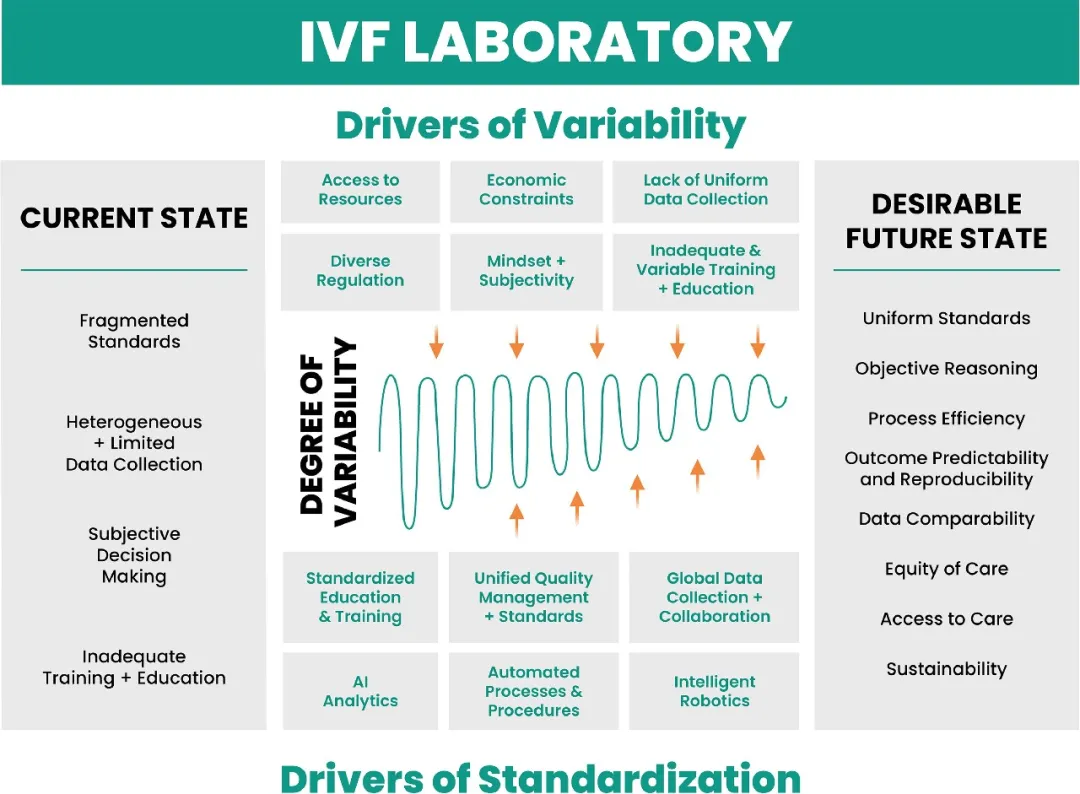
In vitro fertilization (IVF) technology has continued to evolve over the past four decades, with global clinical pregnancy rates and live birth rates on the rise, and the incidence of multiple pregnancies declining accordingly. However, behind this generally positive picture lies a long-standing unresolved challenge – significant differences between laboratories in terms of operational procedures, embryo grading criteria, quality control, and personnel training. This variability not only affects clinical outcomes but also severely hinders the standardization and benchmarking of assisted reproductive technologies worldwide.
Facing this challenge, a series of emerging technologies are bringing opportunities for change. In particular, the rapid development of artificial intelligence (AI) and automated systems is providing more stable, objective, and efficient tools and processes, helping IVF laboratories move towards greater predictability and consistency.
AI in the Laboratory: From Evaluation Tool to Decision Support
The application of AI technology in assisted reproduction began with image recognition tasks, especially in identifying morphological features of sperm, oocytes, and embryos. Currently, several commercial AI models are used to predict blastocyst formation, chromosomal ploidy, or implantation potential. Some preliminary studies have shown that these models may achieve predictive consistency comparable to or higher than manual evaluation in specific tasks, but further verification of their stability and generalizability on diverse, multi-center datasets is still needed.
Beyond image analysis, AI is also being integrated into the laboratory’s quality management system. For example, after real-time data collection on incubator temperature, gas concentration, culture medium parameters, etc., AI analysis tools can help detect abnormalities earlier, enhancing the sensitivity of quality control. This ability for continuous data collection and feedback is expected to become an important support for cross-cycle and cross-laboratory data benchmarking in the future.
Although AI has not yet replaced human clinical judgment, its potential in assisting decision-making has become evident. Especially when embryo quality is in a “borderline” range and expert opinions are divided, AI can serve as an objective reference dimension, helping teams evaluate and select embryos more consistently.

Automated Systems: Enhancing Efficiency and Ensuring Consistency
Another key direction in IVF laboratories is the increasing maturity of automated systems. From early semen analysis and freezing operations to recent automated ICSI injection systems, culture dish preparation robots, and sample tracking platforms, more and more links are attempting to “hand over to machines”.
These systems not only improve process efficiency but also significantly reduce individual differences caused by human operations. For example, automatic culture dish preparation systems can achieve constant volume dispensing and batch processing, while automatic injection systems have better stability in pressure and angle control. Although these systems have not yet been widely deployed in all laboratories, their potential has been supported by several early validation studies.
In practical applications, most laboratories do not adopt “complete replacement” but rather a “human-machine collaboration” model. That is, automated systems handle routine and repetitive tasks, while embryologists with professional judgment deal with complex situations and unexpected problems. Humans still play a core role as supervisors and decision-makers in the process.
Standardization Implementation: Facing Verification Dilemmas, Institutional Deficiencies, and Role Transformation
Although AI and automated systems are continuously advancing, their real implementation still faces many challenges. Firstly, there is insufficient data sharing and foundation for model training. At present, most AI models are still built on local data, lacking extensive validation across multiple centers and populations, which limits their generalization ability among different laboratories.
Secondly, there is a lack of a unified certification framework specifically for ART laboratories globally. Existing certification systems mostly focus on diagnostic laboratory standards and do not fully cover the complexity and particularity of IVF laboratory operations. This institutional deficiency restricts the systematic promotion of standardization.
Meanwhile, technological changes have also brought pressure for role transformation. Some practitioners take a wait-and-see attitude towards the involvement of AI and automation, worrying that traditional skills and judgment will be weakened. However, as experience in other medical fields has shown, technological development ultimately tends not to “replace” but to promote professionals to move towards higher-level management, decision-making, and strategy formulation.
Conclusion: Towards a More Stable, Accurate, and Intelligent Laboratory
The future of IVF laboratories is undergoing a profound yet gradual transformation. From scoring systems to culture environments, from operational consistency to decision-making logic, AI and automation are quietly changing our working methods and reshaping the essential role of laboratories.
We will no longer be merely executors of technology but also organizers of systems, interpreters of data, and responders to complex situations. The ideal future IVF laboratory will integrate the repeatability of artificial intelligence with the flexibility of human judgment, building a modern reproductive laboratory platform that combines standardization, personalization, and sustainability.
Reference
Alikani M, Campbell A. Shaping the future of the IVF laboratory: standardization for more predictable outcomes. Reproductive BioMedicine Online. 2025;50(4):609–614.
https://doi.org/10.1016/j.rbmo.2025.104854