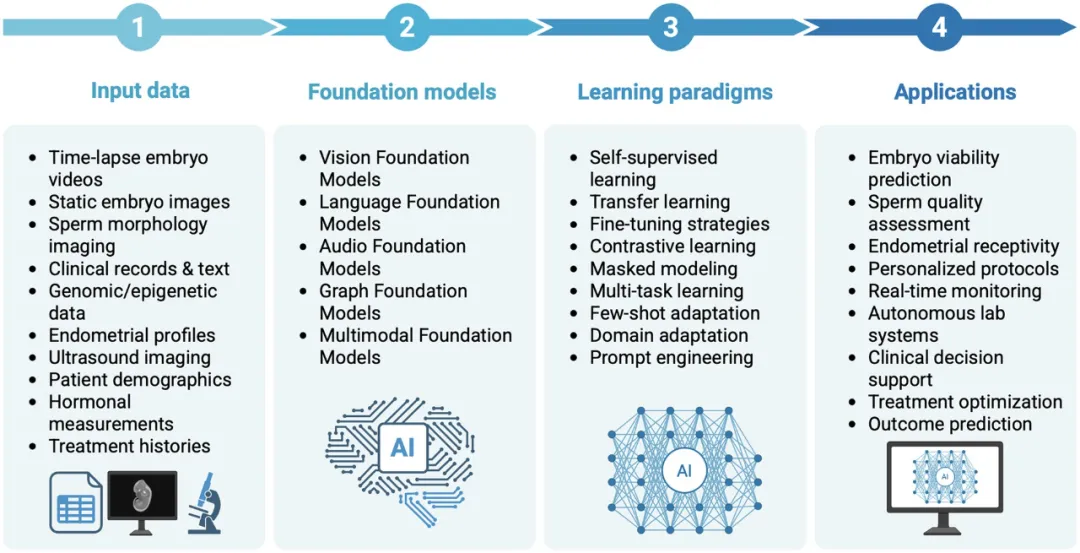
In the field of Assisted Reproductive Technology (ART), artificial intelligence is transitioning from “single-point tools” to “systematic intelligence”. Although traditional AI models have demonstrated value in procedures such as embryo selection and sperm analysis, they are limited by their single-task design and reliance on labeled data. Consequently, they struggle to integrate multi-source heterogeneous data such as images, genes, and texts in clinical settings, failing to fully capture the complexity of the reproductive process. In contrast, foundation models—large neural networks pre-trained on massive and diverse datasets through self-supervised learning—with their powerful multimodal processing capabilities and transfer learning characteristics, are expected to become the “universal intelligent foundation” for the entire ART workflow, driving assisted reproductive technology towards precision and personalization.

From “Specialized Tools” to “Universal Foundation”: Core Advantages of Foundation Models
Traditional AI in ART mostly manifests as “single-point breakthroughs”: embryo assessment models only process static images, and sperm analysis systems are limited to morphological parameters, both requiring substantial manually labeled data for support. This “stovepipe” development model cannot integrate the multi-source information generated simultaneously in clinical practice (such as the correlation between embryo images and patients’ hormone levels, genetic data), let alone reflect the dynamic relationships between various elements in the reproductive process (such as the interaction between embryo development and the endometrial environment).
The revolutionary aspect of foundation models lies in their “universal intelligent foundation” attribute: they extract common patterns from massive amounts of data (including time-lapse embryo videos, genomics data, clinical medical records, etc.) through self-supervised learning, forming transferable knowledge representations. For example, a pre-trained visual foundation model can be simultaneously adapted to multiple tasks such as embryo grading and endometrial ultrasound analysis, without the need for separate training for each scenario. It naturally connects the entire ART workflow (from the optimization of ovarian stimulation protocols to the selection of embryo transfer timing), achieving intelligent collaboration across procedures.
Technical Core: Three Pillars Supporting Foundation Models
The powerful capabilities of foundation models mainly stem from three core technologies:
1.Powerful data processing capability
Foundation models can handle various types of data, including videos of embryo development, genetic information, and clinical records. This capability is similar to how human experts can consider multiple aspects when analyzing complex situations. For instance, by analyzing the dynamic process of embryo development, the model can capture details of cell division, thereby better predicting the developmental potential of embryos.
2.Self-learning capability without heavy reliance on manual annotation
Traditional AI models require a large amount of labeled data for training, which is not only time-consuming and labor-intensive but also prone to errors. Foundation models, on the other hand, can learn patterns automatically from a large amount of unlabeled data through self-supervised learning. For example, the model can automatically learn features in embryo images without the need for manual annotation of each cell’s state. This method greatly reduces reliance on manual annotation and improves the efficiency and accuracy of the model.
3.Ability to flexibly adapt to different tasks
Foundation models can quickly adapt to different task requirements through fine-tuning or specific input instructions. This means that the same model can be used in multiple different scenarios, such as both embryo quality assessment and endometrial analysis. This flexibility makes foundation models have broad application prospects in assisted reproductive technology.
The combination of these technologies enables foundation models to better understand and process complex reproductive medical data, providing more accurate support for clinical decision-making.

Application Prospects in ART: Comprehensive Innovation from Laboratory to Clinic
Foundation models break down data barriers through multimodal fusion, demonstrating multi-dimensional potential in ART. In the field of embryo assessment, the model integrates time-lapse videos, genetic data, and clinical information to construct an accurate viability prediction model. The hybrid system achieves an accuracy rate of 98% and solves the AI “black box” problem through a “two-stage explanation framework”. In sperm analysis, it correlates imaging with epigenetic data to improve the diagnostic specificity of male infertility. In terms of endometrial receptivity assessment, integrating multi-source data improves the accuracy of judging the timing of transplantation and reduces the risk of recurrent implantation failure.
In decision support and personalized protocols, the model integrates patients’ multi-dimensional data, combines massive cases with real-time guidelines (relying on Retrieval-Augmented Generation technology), and generates dynamically optimized protocols. For example, adjusting medication for patients with poor ovarian response and recommending combined strategies for cases with repeated failures, realizing “one thousand people, one thousand plans”.
In the aspect of continuous monitoring, foundation models make up for the shortcomings of traditional intermittent imaging. Combined with high-frequency time-lapse technology, they capture subtle morphological changes and link with culture systems to adjust environmental parameters. They protect privacy through differential privacy technology, forming a “perception-decision-execution” closed loop and upgrading the embryo culture mode. At the same time, the combination of computer vision and robotic technology realizes the automation of embryo manipulation, reduces errors, and standardizes ART procedures.
Challenges and Responses: Practical Considerations for Technology Implementation
The application of foundation models in Assisted Reproductive Technology (ART) faces challenges in both technical and ethical aspects. Technically, ART data is scattered and collected with inconsistent standards, which may lead to biases during model training. To address this, it is necessary to establish cross-center data consortia, unify standards, and use synthetic data technology to enhance data quality. Meanwhile, training foundation models requires high-performance computing resources, resulting in high costs. The threshold can be reduced through lightweight model design and cloud-based shared computing power. In addition, the complexity of the model makes the decision-making process difficult to understand. It is necessary to improve transparency through technologies such as “model distillation” and establish dedicated benchmark datasets and evaluation criteria.
In terms of ethics, the high sensitivity of reproductive data requires strict protection. Technologies such as federated learning and homomorphic encryption can realize multi-center collaboration without leaking original data, ensuring compliance with ethical and legal standards. At the same time, attention should be paid to potential ethical issues arising from the application of the technology, such as avoiding the risk of “designer babies”, clarifying the responsible entities for model decision-making biases, and ensuring the fairness and accessibility of ART services through policy regulation. In conclusion, the application of foundation models in ART requires comprehensive considerations at the technical, ethical, and social levels to ensure their safe, effective, and fair service to patients.

Future Outlook: Moving Towards a New Era of “Intelligent Assisted Reproduction”
Foundation models bring new opportunities and challenges to Assisted Reproductive Technology (ART). Their multimodal data integration capability provides new possibilities for embryo selection, sperm analysis, and personalized treatment protocols. However, issues such as data quality, computational resource requirements, regulatory validation, and privacy protection still need to be addressed. Future research should focus on developing specialized pre-training and fine-tuning strategies, establishing standardized benchmark datasets and evaluation indicators, and promoting interdisciplinary cooperation. Through these efforts, foundation models are expected to achieve more accurate and effective clinical applications in the field of assisted reproduction.
reference
Hammer HL, Thambawita V, Riegler MA. Foundation models: the next level of AI in ART. Hum Reprod. 2025 Jul 15:deaf136. doi: 10.1093/humrep/deaf136. Epub ahead of print. PMID: 40663772.