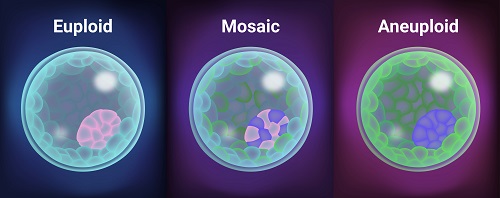
he paper introduced in this article focuses on the core needs of the assisted reproductive technology (ART) field and conducts research on embryo ploidy testing, a key link to improve the success rate of in vitro fertilization (IVF). The paper points out that although the traditional invasive preimplantation genetic testing for aneuploidy (PGT-A) can accurately identify euploid embryos, it has problems such as embryo damage caused by biopsy and result interference from chromosomal mosaicism; conventional morphological evaluation, due to low efficiency and strong subjectivity, leads to a singleton live birth rate of only about 30.8% in women aged 35-37 years. Based on this, the paper systematically analyzes the technical logic, advantages, and limitations of artificial intelligence (AI) in embryo ploidy selection, and combines two technologies—non-invasive preimplantation genetic testing for aneuploidy (niPGT-A) and metabolomics—to clarify the synergistic value of the three, providing comprehensive references for clinically formulating safer and more efficient non-invasive embryo selection protocols.
Munné S, Horcajadas JA, Seth-Smith ML, Perugini M, Griffin DK. Non-invasive selection for euploid embryos: prospects and pitfalls of the three most promising approaches. Reprod Biomed Online. 2025 Jun 10;51(5):105077. doi: 10.1016/j.rbmo.2025.105077. Epub ahead of print. PMID: 40934618.
1. AI for Embryo Ploidy Selection: Technical Logic and Core Advantages
The core of AI in embryo ploidy selection is to capture subtle ploidy-related features through image analysis to achieve non-invasive and standardized evaluation. It mainly adopts two types of technical approaches: one is based on static images, analyzing morphological features such as the integrity of the inner cell mass and the arrangement of trophoblast cells at specific embryonic stages (e.g., day-3 cleavage stage, day-5 blastocyst stage) to establish models; the other relies on time-lapse imaging (TLI) to track the dynamic process of embryonic development, extract kinetic parameters such as pronuclear disappearance time and cell division interval, and judge aneuploidy risks through parameter abnormalities.
At present, a variety of AI systems have been applied in clinical practice, which can be divided into TLI video-dependent and static image-based categories according to input data types. Some systems show outstanding performance: the accuracy of ploidy prediction mostly ranges from 60% to 80%, and the ROC-AUC (Area Under the Receiver Operating Characteristic Curve) is concentrated between 0.68 and 0.74, overall falling within a relatively stable practical range. In clinical practice, AI’s advantages are more prominent: in nearly 80% of embryo cohorts, AI can rank euploid embryos as the first choice for transfer, and the proportion of euploid embryos identified by AI (about 47%) is higher than that of manual selection by embryologists (about 39%) and random selection (about 37%). Meta-analyses further confirm that the pooled sensitivity, specificity, and AUC of AI for embryo ploidy prediction are approximately 0.71, 0.75, and 0.80 respectively, which can already serve as a non-invasive alternative for patients unsuitable for biopsy (e.g., small number of embryos, poor embryo quality).
In addition, the efficiency and standardization of AI are irreplaceable: the evaluation of a single embryo only takes a few seconds, and the efficiency is more than 10 times higher than that of manual evaluation; the consistency of manual embryo scoring is about 60%, while that of AI exceeds 90%. For “medium-quality embryos” (accounting for more than 60% of clinical transfers), the judgment deviation rate of AI is 25% lower than that of manual evaluation, greatly reducing subjective errors.

Performance of Some Commercial AI Systems
2. Key Limitations of AI for Ploidy Selection: Data, Equipment, and Generalization Issues
The technical shortcomings of AI must be addressed. Firstly, there is a bias in training data. Some studies include “discarded embryos” (embryos abandoned for transfer due to poor morphology) and label them as “having no live birth potential”, but some of these embryos still have viability. This causes AI to be good at distinguishing between “excellent” and “poor” embryos, but difficult to accurately evaluate “medium-quality embryos”—in some studies, the AUC of AI is falsely elevated to above 0.9 due to data bias, while in real clinical datasets (with clear outcomes of all embryos), the AUC drops to 0.6-0.7.
Secondly, there is strong equipment dependence and weak generalization ability. Approximately 5/9 of core AI systems rely on specific TLI equipment (e.g., EmbryoScope) and cannot be compatible with other equipment or static images, limiting their application in small and medium-sized IVF centers. At the same time, AI has differences in adaptability to patients of different age groups: the AUC of AI for predicting live birth of embryos from patients over 35 years old reaches 0.745, while it is only 0.661 for young patients (<35 years old). This is because the quality of embryos from young patients has small differences, making it difficult for AI to capture effective features.
In addition, the limitation of clinical endpoints also needs attention: most AI systems take “clinical pregnancy” (e.g., HCG positivity) as an indirect endpoint rather than “live birth” (the gold standard for IVF success). However, live birth is affected by various extra-embryonic factors such as maternal diabetes and cervical incompetence, and AI based solely on images cannot incorporate these variables, which may overestimate its clinical value. For example, the accuracy of one AI system in predicting clinical pregnancy is 76.3%, but its accuracy in predicting live birth is only 71.2%, showing no statistically significant difference from conventional morphological evaluation (70.0%).
3. niPGT-A and Metabolomics: Supplements and Synergy with AI
In the non-invasive selection system, niPGT-A and metabolomics are important supplements to AI. niPGT-A evaluates ploidy by analyzing cell-free DNA in embryo spent culture medium (SCM) or blastocoel fluid. When sample control is strict, its consistency with invasive PGT-A reaches 100%; after process optimization (e.g., removing cumulus cells, extending culture to day 6) in multi-center studies, the consistency can also be increased to 82.5%-94%. Clinically, the cumulative live birth rate of the niPGT-A group (44.9%) is significantly higher than that of the non-test group (27.9%) and close to that of the invasive PGT-A group (51.0%), which can serve as a “precision verification tool” after AI preliminary screening to reduce the risk of AI misjudgment.
Metabolomics assists in ploidy evaluation (with a consistency of over 90% with PGT-A) by analyzing metabolites such as amino acids and glucose in the spent medium, and can uniquely identify “genetically euploid but metabolically non-implantable embryos”—these embryos account for about 30% of the total euploid embryos, which is a gap that AI and niPGT-A cannot cover. For example, detecting the level of caspase-3 in the spent medium can judge the degree of embryo apoptosis, and low levels of caspase-3 are associated with a higher pregnancy rate (P<0.05). Moreover, this technology is not affected by fertilization methods and can add a “functional qualification” label to embryos selected by AI.

Impact of Different Sampling Times on niPGT-A Detection Accuracy
4. Positioning and Future Optimization of AI
In non-invasive selection, AI acts as an “efficient preliminary screener”, suitable for centers with a large number of embryos or limited equipment. It can improve efficiency and reduce errors, but it needs niPGT-A to verify accuracy and metabolomics to supplement functional evaluation. Future optimization should focus on three aspects: first, jointly establishing a multi-center standardized database of “image-ploidy-live birth” comprehensive information, eliminating biased samples, and improving the ability to evaluate “medium-quality embryos”; second, developing general algorithms compatible with multiple devices and adapting to different laboratories through transfer learning to lower the application threshold; third, integrating embryo images and patient clinical data to build a “ploidy-function-live birth” full-chain prediction model and improve the ability to correlate with clinical outcomes. With the gradual maturity of the synergy between AI and other technologies, the model of “AI preliminary screening → niPGT-A verification → metabolomics evaluation” is expected to become a new paradigm in assisted reproduction, improving the success rate of IVF while ensuring embryo safety and promoting the precision development of the industry.